What I did
 |
| A diagram illustrating the sequence of Norman's three levels of design. |
Visceral Aspect
The natural inclination to attractiveness
beyond cultural understanding, from a biological level.
Our initial reaction to any sensory is based on our basic visual judgement of it.
Symmetry, bright colors, curves
Apple plummets in sales until it introduces slick and colorful designs
(even though the hardware remains constant)
(even though the hardware remains constant)
Behavioral Aspect
This is the functionality of a design.
If the design proves to fail it's ultimate purpose, it is not working behaviorally.
Consumers and users often blame themselves
when a design is lacking in it's sequence of actions.
To create the behavioral design well, you must pay attention
those attempting to use the design and see the steps in which they handle it.
Two kinds of product development:
Enhancement
Innovation
"How do you discover a need that nobody yet knows about?"- 70
"the real challenge to product design is "understanding end-user unmet and unarticulated needs."- 74
"the real challenge to product design is "understanding end-user unmet and unarticulated needs."- 74
Reflective Aspect
Concerns with the meaning of a design in culture, time, and setting.
The personal emotion a user gets from a design is reflective
as well as the image they are perceived by those around them.
"Do you sometimes avoid a purchase "because it wouldn't be right" or buy
something in order to support a cause you prefer?" -84
The first things that come to mind in response to the quote above are:
If some men purchase tampons/feminine products they fear they will be looked
down on by the cashier or whomever sees them with it.
I have purchased Dawn soap products because they support cleanup of wildlife after
the recent oil-spill catastrophe. Even though I would usually disregard the brand
for a cheaper soap, the cause means a lot to me so I'm drawn to buy it.
______________
I spent 1 hour reading through this pdf that I found online from an 07 class at Indiana University.
This paper is a thesis explaining how interaction with designs (in this case mainly technological) can create, mold, and promote sustainable behaviors.
Longevity of the design
The environmental effect the design has while in use
The environmental consequence when it is discarded
This paper is a thesis explaining how interaction with designs (in this case mainly technological) can create, mold, and promote sustainable behaviors.
Longevity of the design
The environmental effect the design has while in use
The environmental consequence when it is discarded
Sustainable Interaction Design: Invention & Disposal, Renewal & Reuse
______________
I took some time (about 15 minutes) to look at this website that was attached to ctools, and it excited me.
Jiyeon Song created a "pavilion" that used sunlight to create type through the geometric form.
The geometry, shape, and clever application of light to shape to create type is very inspiring. It makes me think about what other applications a package design could function with on a smaller scale.
______________
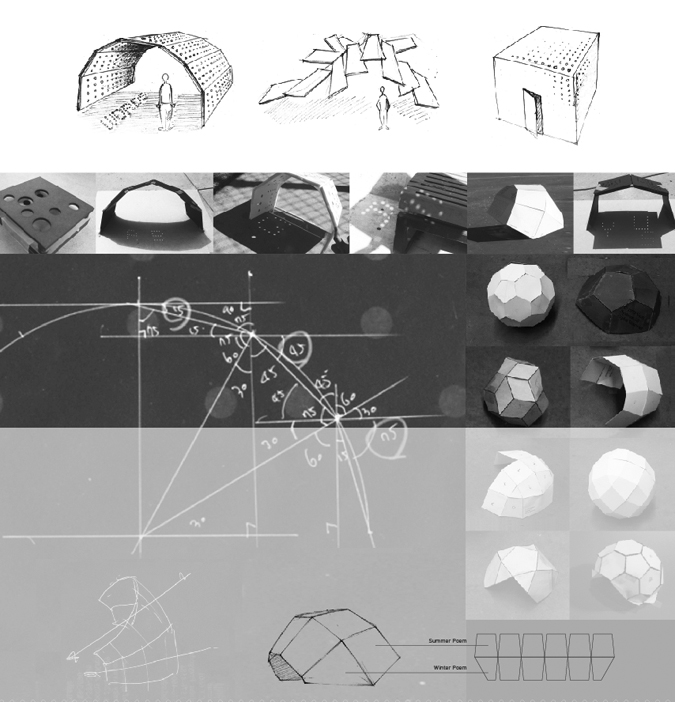 |
| Sketches for One Day Poem Pavilion by Jiyeon Song |
I took some time (about 15 minutes) to look at this website that was attached to ctools, and it excited me.
Jiyeon Song created a "pavilion" that used sunlight to create type through the geometric form.
The geometry, shape, and clever application of light to shape to create type is very inspiring. It makes me think about what other applications a package design could function with on a smaller scale.
 |
| Kyo Yang's design to show expiration. The package responds to the milk's chemistry. |
I continued to look up inspiring packaging for another 20 minutes, and print them to hang in my studio.
 |
| Add caption |
For my "make something" project, I created three mono-type prints in a period of 2.5 hours. I had the unaltered prints hanging on my studio wall for a few days. However, I had an inclination to manipulate them, take a knife to them, and play with the 2-d surface. I began by cutting the head of my largest print, and folding the cuts to create a "bulging" area. I was ultimately unhappy with this, but glad that I made the decision to advance upon something that I had worked so long on, instead of just speculating in my head. Then, the next two square prints were folded into a cube and 'vase' shape, to see how the inner and outer surfaces work with each other. This process took 2 hours as well.


What I discovered
After all of the explorations, I've found precious pieces of information and inspiration to help mold my ideas onto a certain path. The text that I read each is relevant to put to use on my IP. The inspiring sources of Jiyeon Song and Kyo Yang made me anticipate doing something unheard of. The exercises done in class and in the studio pushed me to develop my ideas further, and stopped me from getting stuck in one place.
What to do next
For the next week, I plan to look back at this research and look for more sources as my ideas begin to flesh them out. I also plan to do explorations by hand in folding, cutting, and drawing.

No comments:
Post a Comment