Thursday, September 29, 2011

Week 3

What I did
*Organizing new posts in a clearer way: habit from last week. 

Monday: 2 hours spent during the evening after I was sick all day, and came up to print out templates from The Packaging and Design Templates Sourcebook included cd. I built a few designs just to work with my hands and see what certain features were used for and whether or not they were necessary.


Tuesday: 3 hours during studio hours spent building more templates and folding materials. Spoke to James about where I am at in my process. We came to the conclusion that I would sacrifice the social benefit of the package in order to keep a shock value. This was something I discussed in the classroom with my group and what I had found the best advice was that no one should sell themselves short by staying within a self-promotional boundary. IP allows you to push the limits. That is something I want to do whether in the object itself, what it is used for, or in what setting it takes place.
I also began to use my life-cycle journal for objects, but it's proving to be less successful than I hoped because my first object is a pencil, and I'm obviously using it at all times if I'm writing about it.


Notes taken during discussion with group
Notes taken when talking to James


Wednesday: 1 hour looking up artists who work with transformable packaging. 
These are two that I found of note:

Elke Decock transformable cake box into a cake platter.
elke decock transformable cake box: Surprisingly, this was one of the only transforming packaging designs that I found on the web by a named artist. It begins as a cake box and transforms into a platter with a given set of instructions.

This project wasn't necessarily about packaging, but more about folding an object flat and sustainable design. The lamp is made of wood pieces that can fold down.

 .5 hours spent doing sketches of possible packages. I realized that trying to write my draft project proposal was extremely difficult when I didn't have anything more than vague hypothetical scenarios to put my idea into. So, I came up with very bad designs for objects off the top of my head, but it was a useful exercise since I have had trouble of knowing where to start with this.
My brainstorm of transforming packages


.5 hours spent talking to Mark (my contact to the homeless shelters) about potential observation. He told me that with confidentiality laws and privacy, that most shelters won't allow someone to come in and watch anyone. He said the only way to do that would be to volunteer working in the shelters, then observe on my time. Interviews were much more likely, but it's not what I want to do right now.When I asked if I could just stay at a shelter, he got slightly irritated and said they would assign me a caseworker, a file, and other resources that I wouldn't need if I was just staying a few nights. Even so, when speaking with him I realized that this sort of audience wouldn't be an appropriate start for my project since most packaging needs to be purchased (unless it is ordered in bulk). It is still possible, and I wasn't discouraged, he just reminded me that it wasn't as easy as strolling into the shelter and asking to watch people. After our conversation, I thought that a school environment would be more appropriate due to the mandatory supplies students are required to purchase.

1 hour spent in my Slavic class discussing Schulz's The Street of Crocodiles and it's theme of 'modern degradation'. The polish guest professor said something that I thought was very relevant to my project. She said that western ideas in economics influenced specialized products that "only work in one specific way for one specific thing" with short life-spans. This allows our economy to bustle, by requiring more items to do all the things we need, and to replace them. Yet it made me think of sustainability and how this cycle is wasteful. If I could prolong the life of a package for a short while longer, I might have made a difference in people's behavior towards packaging.

Reading The Street of Crocodiles- Bruno Schulz


Thursday: 40 minutes spent in groups evaluating proposal drafts. When mine was discussed, people had a hard time figuring out what my purpose was, understandably, since my proposed design issue isn't existent yet. We spoke about ways to think about it, basically to work from my own personal design issues as practice.

3 hours spent in the studio working on template exploration as well as discussing future goals with my partner. I decided that the best route to take from here would be to come up with various scenarios as well as various items that I can sketch their preliminary package and their possible transformed packages. I started to do this last night, and I think it is the only way to get my mind working. I also talked about habits that I want to enforce, such as tracking my time more efficiently, and taking care of myself. One thing I want to do is to leave the studio when I'm feeling 'stuck' and take notes outside to clear my mind. I think the change in scenery might help me think.

What I've discovered
This is frustrating, really frustrating. I have an idea that I'm passionate about, a medium that I'm excited to delve into, but I'm having such a hard time finding a starting point for my design issue. On top of that, writing about my project becomes more and more obscure as I try to explain it in abstracted ideas. AH. I think that I'm on the right track. I also think that deciding on an audience right now is running before I can walk. Right now, I need to think of design issues anywhere, just so I am thinking of them.

Next
I plan to develop ideas about potential packaging and their transformable counterparts. I think this exercise will be more productive than what I've been doing so far, although I've been trying. It is crucial that I come up with some ideas, however weak, to talk about in my IP proposal. I also want to continue to find inspiration from other artists. That is a comforting feeling for some reason. Everything I've been doing thus far has been productive, even though I feel like I'm in a rut. I will continue the process I've started and more.


Thursday, September 22, 2011

Week 2

What I did

This week, I spent a great deal of time collecting text material on packaging concepts, as well as templates. I spent 1 hour on tuesday during our IP workshop at Tappan hall collecting materials that caught my eye. These, unlike the other books which I had found, were not directly related to packaging.

During my 3 hour studio session on Tuesday, I delved into the texts. I had the concept of a 'life-cycle' journal in mind while doing this, so I found a lot of sections in various books dealing with re-design process. This concept came from my group discussion on Tuesday with James and Juliet, as a suggestion to begin thinking of design issues, starting with my everyday life. I spent 30 min on Thursday creating a miniature booklet to carry around and begin this process.

The first book that I picked up from Tappan Hall, Travel through Europe, touched on some distributive aspects I thought of in my piece. The book is composed of various work of design agencies from all over Europe, who mail their work to a specific studio in Barcelona, to promote traveling through graphics. I spent 3 hours in the studio and at home on wednesday browsing through Travel through Europe, thinking of how this mass produced, promotional aspect of interaction might help my piece.

I first began thinking of this aspect of distribution of packaging when I began to work on my 2-20 sketch variations of dream projects. When thinking of an audience for my main idea (a practical package that transforms into its use when folded), I thought of under-resourced areas that may come of use for the sustainability of two functions in one material. When I met in my 1 hr discussion with James, Juliet, Ryan, Marian, and Jimmy, I was given feedback that I should think about design issues that would need to be worked out for that audience. For a 30 min today, I spoke to Professor Smotrich about what kinds of communities may be of use to a project like this (such as elementary students, the elderly, the autistic etc) to broaden my scope of audience. From here on, I plan to make a list of as many communities that may be of use to sustainable, practical, and transformation packaging, then come up with reasons why the physical construction or concept may pose a problem (such as arthritis in the elderly, motor skills in mentally challenged...). 

I spoke to Matt Shlian for about 15 minutes about my project and keeping in contact with him if I should need any resource. He was happy to help.

When I spoke to Krista (my partner for Tuesday) and Professor Smotrich, I confessed that my biggest challenge thus far was getting into making anything physical. For my 3 studio hours today, I spent time in the Duderstadt researching packaging template books and began to print them out and assemble them. The physical act of creation felt wonderful after all of my scattered thoughts. Jan Henrik once said something along the lines that you can think as much as you want, but until you begin to physically make something, you are completely unaware of certain design issues and thinking that only accompany this process. I think a balance of the two is a place to start.

I also spoke to Dylan Box ( an IP student) about his planned project. He said that he wanted to make furniture or products that were created out of materials from abandoned buildings in Detroit. I immediately thought of a connection between the reuse of his materials, and of my conceptual idea where the material is transformed. I also thought of the possibility of distributing this to an underprivlidged area. When I told him my thoughts, we discussed a possible colaberation of gallery space and even more so, he showed me a related lamp that he had made the previous semester. The container was made of brown cardstock and was pre-installed with a small light bulb. When you pulled on the bottom of the container, it extended into a vertical rectangle of paper. Then you attached a cord and a light made from it's very package was displayed. I found a project similar to this in one of my packaging design books, where the package was made from thick mylar-like material. You then folded the box in a few areas, installed the light, and you had a modern-looking fixture to hang in your room. Ikea also had a lamp like this in their recent catolog, but made of paper. These transformative packages are along the lines of things I want to explore.

After reading the New York times Article for 20 minutes during class time (after the professors went to visit the first studios), I thought about keeping up good habits with constant research as well as exercises to keep me thinking about my project. I think the 'life-cycle' journal will be able to change my thinking pattern around seemingly mundane actions I take through out the day.


What I discovered

Most importantly, I found that I need to change my habits to organize my thoughts. When speaking about my project, I am often jumping around between ideas without a concrete message to say. Basically, I want to say that "For my IP project, I would like to create packaging that can transform into a practical use (for an under-resourced audience)." I am happy to say that I have found a path that I'm passionate about, but I'd like to have more specificity. I also discovered that there are endless resources in the Duderstadt to use, right now I have like 15 books checked out. I feel like an addict. I also know that it can't be my only resource, I have to jump out of my 'comfort zone' to make any progress since I am dealing with real-life issues that take place outside of my studio.

 What I plan to do next
For the next week I plan to get contacts from various shelters and explain my project to the staff in hopes to observe there. Before this, I want to write a concrete description/proposal of my project so I won't confuse anyone like I have been lately, especially these contacts. I will begin to fill up my 'life-cycle' journal for packages/products that I carry around to see when a design-issue occurs. I also want to stick my toes into the water by finding a 'case-study' sort of contact whom I can interview, and observe before jumping straight into a community. I plan to make a list of all the possible communities I can look at and think of what resources are lacking. Perhaps I will get in contact with teachers who feel that their schools are lacking certain materials. BUT MOST OF ALL I will create various packaging from templates to get a feel for the shapes and to begin to work.

Tuesday, September 20, 2011

Feedback 2-to-20

I shared my ideas from last week with added variables to Jame's and Juliets' group.
(I can't describe how useful it is to explore without limits
and to hear yourself explain what you didn't understand to a group.)

My favorite idea is to create a package that can be folded/manipulated to serve as an object.
'HangerPak' by Steve Haslip inspired me over the summer to think of sustainable material packaging  

people react to packaging. I want to find a design issue.
As the book Emotional Design mentioned, you can't ask a consumer
"what do you think needs to be designed" without missing the core problems.
People are unaware that a design is failing, or that they need something
that they have never experienced before in daily life.
In discussion, I really focused on the community and public aspect of
the design. When thinking of an audience, I thought of
those who are lacking certain 'luxeries' of practicallity in their homes.
Then I thought of going to homeless shelters to observe what
material goods they lack. I have a close friend who has worked
in about every homeless shelter in ann arbor, who may be able to give
me information on contacts.

I was also given a suggestion to observe my own 'action-sequence'
with a series of objects that I carry thoughout the day. I will log
what I do when I need to put it down, carry it, use it, or attempt to store it.

Another idea that I thought of was a way to use the package
to filter air, or something crazy like that for innercity areas.
From living in Melvindale as a kid, I know that material accessibility is less of an issue
than the air quality.
Right now it sounds farfetched, but I'm pretty excited about all of this.


Thursday, September 15, 2011

Week 1

What I did


A diagram illustrating the sequence of Norman's three levels of design.
  This week I've spent a total of 3 hours reading Emotional Design by Donald Norman. I decided I would begin reading over the process behind any design, mainly referring to product design in Norman's book. I wrote some quotes out in my journal that stuck out to me.


Visceral Aspect
The natural inclination to attractiveness
beyond cultural understanding, from a biological level.
Our initial reaction to any sensory is based on our basic visual judgement of it.
Symmetry, bright colors, curves 
Apple plummets in sales until it introduces slick and colorful designs
(even though the hardware remains constant)

Behavioral Aspect
This is the functionality of a design.
If the design proves to fail it's ultimate purpose, it is not working behaviorally.
Consumers and users often blame themselves 
when a design is lacking in it's sequence of actions.
To create the behavioral design well, you must pay attention 
those attempting to use the design and see the steps in which they handle it. 
Two kinds of product development:
Enhancement
Innovation


"How do you discover a need that nobody yet knows about?"- 70
"the real challenge to product design is "understanding end-user unmet and unarticulated needs."- 74

Reflective Aspect
Concerns with the meaning of a design in culture, time, and setting.
The personal emotion a user gets from a design is reflective
as well as the image they are perceived by those around them.

"Do you sometimes avoid a purchase "because it wouldn't be right" or buy
something in order to support a cause you prefer?" -84

The first things that come to mind in response to the quote above are:

If some men purchase tampons/feminine products they fear they will be looked
down on by the cashier or whomever sees them with it.
I have purchased Dawn soap products because they support cleanup of wildlife after
the recent oil-spill catastrophe. Even though I would usually disregard the brand
for a cheaper soap, the cause means a lot to me so I'm drawn to buy it.

______________
 
I spent 1 hour reading through this pdf that I found online from an 07 class at Indiana University.
This paper is a thesis explaining how interaction with designs (in this case mainly technological) can create, mold, and promote sustainable behaviors.
Longevity of the design
The environmental effect the design has while in use
The environmental consequence when it is discarded
Sustainable Interaction Design: Invention & Disposal, Renewal & Reuse

______________
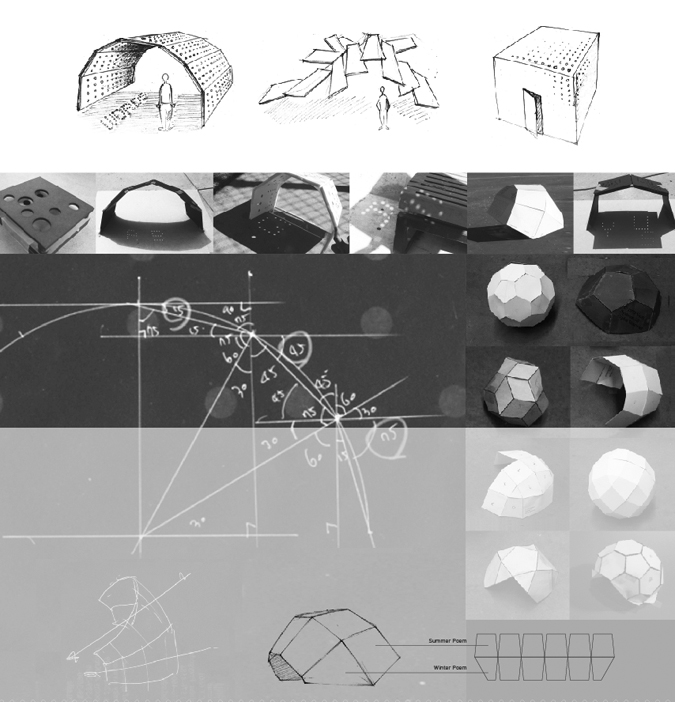
Sketches for One Day Poem Pavilion by Jiyeon Song

I took some time (about 15 minutes) to look at this website that was attached to ctools, and it excited me.
Jiyeon Song created a "pavilion" that used sunlight to create type through the geometric form.
The geometry, shape, and clever application of light to shape to create type is very inspiring. It makes me think about what other applications a package design could function with on a smaller scale.


Kyo Yang's design to show expiration.
The package responds to the milk's chemistry.


I continued to look up inspiring packaging for another 20 minutes, and print them to hang in my studio.


Add caption
In class we created our "dream project sketches" in 40 minutes or so. I used up all of my paper with rough ideas that mainly contained computational elements. I've noticed from the exercise that these computational elements stand in for a type of interaction between the user and the design, which is a great thing to keep in mind when thinking about packaging that responds to the user. I spent 15 minutes sorting through the ones that I didn't feel were worth expanding on. This proved to be somewhat difficult because many of the ideas were repeated in slight variations and extremely rough.


For my "make something" project, I created three mono-type prints in a period of 2.5 hours. I had the unaltered prints hanging on my studio wall for a few days. However, I had an inclination to manipulate them, take a knife to them, and play with the 2-d surface. I began by cutting the head of my largest print, and folding the cuts to create a "bulging" area. I was ultimately unhappy with this, but glad that I made the decision to advance upon something that I had worked so long on, instead of just speculating in my head. Then, the next two square prints were folded into a cube and 'vase' shape, to see how the inner and outer surfaces work with each other. This process took 2 hours as well.


What I discovered
After all of the explorations, I've found precious pieces of information and inspiration to help mold my ideas onto a certain path. The text that I read each is relevant to put to use on my IP. The inspiring sources of Jiyeon Song and Kyo Yang made me anticipate doing something unheard of. The exercises done in class and in the studio pushed me to develop my ideas further, and stopped me from getting stuck in one place.


What to do next
For the next week, I plan to look back at this research and look for more sources as my ideas begin to flesh them out. I also plan to do explorations by hand in folding, cutting, and drawing.